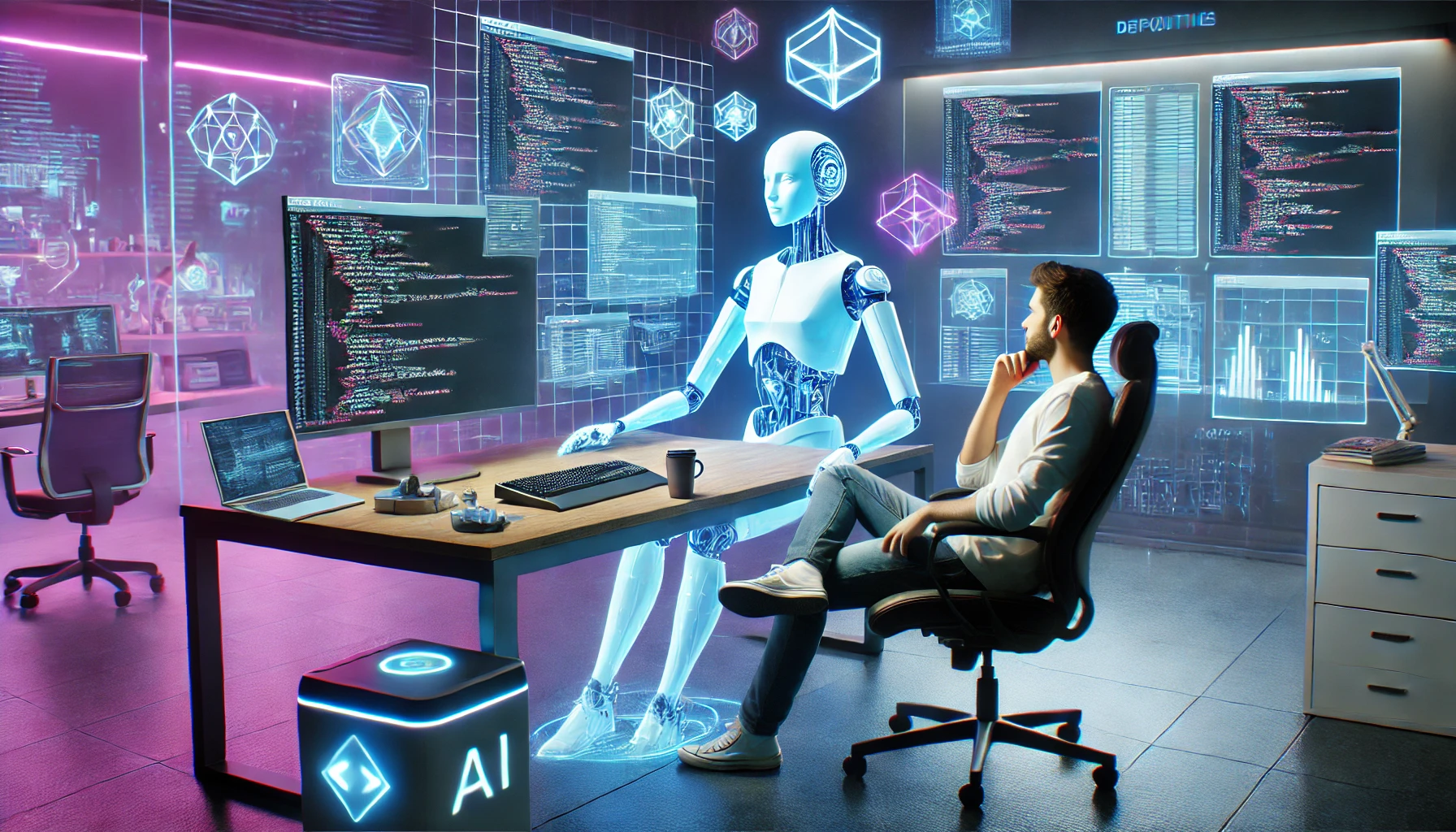
My Experience with Vibe Coding
When I first heard about Vibe Coding, I thought, “Great! Another futuristic tool to make me feel both amazed and slightly inadequate.” So, I signed up for a short course on Vibe Coding offered by DeepLearning.AI, expecting to struggle through complex concepts. Instead, I was pleasantly surprised to find a course that made app development feel like magic.
This course introduced me to an entirely new way of building applications—one that requires little to no coding. The session was engaging, featuring presenters from Replit who broke down the concepts into simple, digestible insights with hands on projects. I also got my own hands-on experience by creating my own project, allowing me to explore the capabilities of Vibe Coding firsthand. Spoiler: It was mostly amazing, with a few AI-induced moments of frustration.
What is Vibe Coding?
Vibe Coding is an AI-assisted development approach that enables users to build applications efficiently without writing extensive lines of code. Platforms like Replit integrate such technologies, making it easier than ever to bring ideas to life. The most fascinating aspect of Vibe Coding is its speed and efficiency—entire applications can be built in a fraction of the time it would take through traditional development. It’s like asking AI to make you a gourmet meal in minutes, except sometimes it forgets the salt.
5 Key Lessons I Learned in the Course
- Thinking: Structuring ideas and providing clear instructions for AI to generate relevant code.
- Framework: Understanding how Vibe Coding tools function within a structured development environment.
- Checkpoints: Regularly saving progress and iterating in small steps to maintain control.
- Debugging: Identifying issues effectively, though it’s more challenging without direct coding experience.
- Context: Providing detailed and precise prompts to ensure accurate code generation.
5 Essential Skills for Vibe Coding
These five essential skills were highlighted in today’s class for making the most out of Vibe Coding:
- Be precise: The clearer the instructions, the better the outcome.
- Focus on one task at a time: Tackling multiple features at once can confuse AI-generated code. Multitasking is great…for humans. AI? Not so much.
- Keep it organized: Structuring projects well leads to better maintainability.
- Start fresh for new features: A clean session ensures AI-generated code is not biased by previous iterations.
- Revert when necessary: If something breaks, reverting to a previous version can be the best solution.
My Hands-On Experience with Vibe Coding
During the course, I decided to create a web application to test the efficiency of Vibe Coding and I wanted to see if AI could create the entire app without any help from me. Since I don’t enjoy cooking (and my fridge is mostly a storage unit for expired yogurt), I thought it would be fun to create a meal-planning and recipe search app. I gave the AI some basic prompts, expecting it to struggle, but what it built with minimal input was genuinely impressive. The app had a clean layout, easy navigation, and even suggested meal plans based on dietary preferences. For a brief moment, I thought, “Wow, maybe I’ll actually start cooking!” Spoiler alert: I did not.
However, things took a turn when I tried adding a more advanced feature - an option to play background music while I read the recipe. The idea was that the app would play music based on the cuisine - Italian for pasta night, some jazz for a fancy French dish, or dramatic orchestral music for when I inevitably burn something. The AI-generated code enthusiastically attempted this…and failed spectacularly. No matter how many times I retried, the app stubbornly refused to play the music. It felt like arguing with a toddler who insists they are wearing their shoes properly when, in reality, the left shoe is on the right foot, and the right shoe is on the left. If you’re a parent, you’ve experienced this firsthand. Long story short: I had to roll up my sleeves and fix it myself.
The Future of Vibe Coding
There’s no doubt that Vibe Coding is a game-changer, allowing rapid development with minimal coding knowledge. However, it raises an important question: How do we ensure the quality of the generated code? Since we are not developing from scratch, understanding and maintaining the code can be difficult. One approach would be to break projects into small chunks, understand it, test each component thoroughly, and ensure that each update integrates seamlessly before moving forward.
Although I wouldn’t feel comfortable pushing AI-generated code to production without a thorough review, I believe that as AI-powered development tools improve, debugging and quality assurance will become more reliable. While Vibe Coding is not perfect today, the future looks promising. We can expect AI to build more stable and efficient applications as these technologies continue to evolve.
In the meantime, for those who want to experiment with building applications quickly, Vibe Coding is definitely worth exploring. It’s an exciting step toward a future where anyone, regardless of coding experience, can create powerful applications with ease—just be ready to wrestle with AI logic now and then!